Spring sapping is the process which causes a spring supplying a stream to cut back upstream, so lengthening the stream. If a spring intercepts another stream flowing across its path, it is said to capture the water from the intercepted stream, diverting it along its own valley. At the point of interception, the valley shows a sharp change in direction, referred to as the “elbow of capture”.
The capturing stream is invigorated by the fresh supply and becomes the dominant stream and erosion of its valley is accelerated. The valley of the captured stream, immediately downstream of the elbow of capture, becomes dry because of loss of its water supply. If the dominant valley continues to cut downwards it can leave the dry valley at a higher elevation than the dominant valley which is then sometimes referred to as a “Hanging Valley”.
In the absence of a structural control, a combination of valley which shows a sharp change in direction at the junction with a dry valley is usually evidence of stream capture.
Photo 1 shows a spring cutting back, in The Wilderness south of Bourne Park House. This is one of the seasonal springs which supply the Nailbourne. If it continues to lengthen along its present southward trajectory, it will capture the Nailbourne upstream of its present confluence. (Perhaps this could be regarded as a self-capture?).
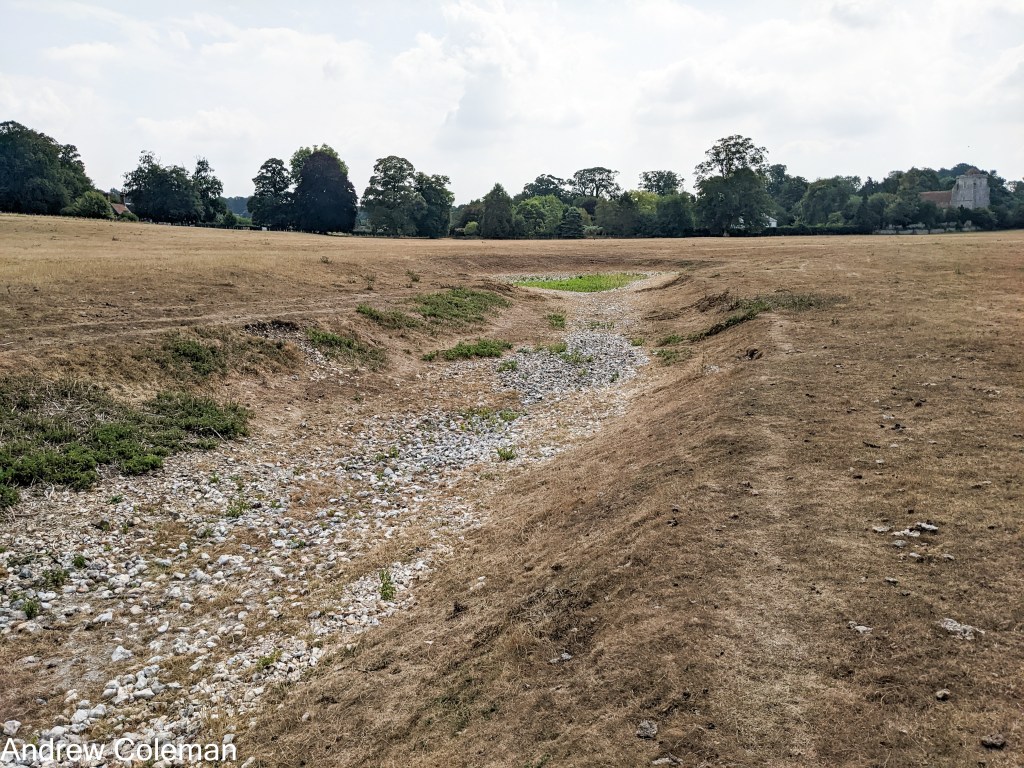
Photo taken in the dry summer of 2022, note the still thriving vegetation at the site of the spring indicating that the water table is close to the surface.
Andrew Coleman
Rev. 30/12/2022
 Geomusings