

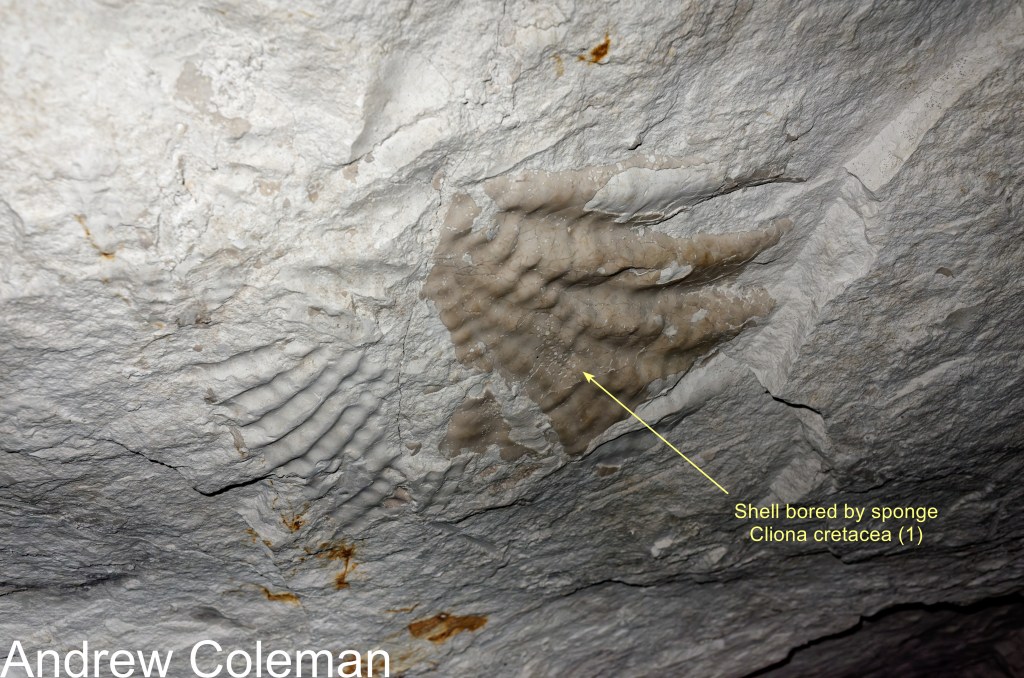
A fragment of a fossil clam shell in the Fan Bay Deep Shelter tunnels at the National Trust’s White Cliffs of Dover site.
The following photo shows fragments of the clam Cladoceramus undulatoplicatus in the roof of the tunnel above the sheet flint in Photo 2 of “How were flints in chalk formed?”
(1) Mortimore, R N. (2021 Fig. 14.6B).
It is rare to find such a well-preserved example of a fragment of this clam shell, which is also referred to as a Snowshoe Clam (Everhart, 2017, p. 44). This fossil species only occurs in the Chalk and spans a relatively short period of about 86.3 to 83.6 million years (though “probably no more than a couple of hundred thousand years” has also been suggested (Everhart, 2017)). It is an internationally recognised index fossil used to define the Coniacian/Santonian Stage boundary in the Chalk at 85.7 +/- 0.2 million years (International Chronostratigraphic Chart, ICC v 2024/12).
The name Snowshoe Clam is appropriate. These clams were large, up to 1 metre across, and they lived on the seabed, which was a soft, chalky ooze. To prevent sinking into the sediment, they had thin shells compared with many clams, which minimised their weight. They also evolved features reminiscent of old-fashioned snowshoes, which aid walking on soft snow without sinking into it. The snowshoe and the clam both have an undulating underside, folded like a fan (plicated). The undulating plicae increase the surface area in contact with the soft, chalky ooze, which reduces the pressure from the applied weight and the amount of settlement into the soft material. The undulations are also reminiscent of corrugated metal sheet (“wriggly tin”), which provides rigidity to an otherwise flimsy sheet material – also applicable to a large, thin-shelled clam.
Normally, these fossils are seen in section on vertical exposures, where they appear as unremarkable thin, wavy lines. If they are seen in plan, it is usually on a bedding plane exposed on a fallen chalk block at the base of a sea cliff. These exposures are short-lived, as they are rapidly broken up by subsequent high tides. This example is protected from the elements and has remained in its current state of preservation since 1941, when the tunnels were excavated.
The sponge Cliona cretacea bores into the shell by dissolution. In this example, the holes are on the side resting in the sediment. Presumably, when alive, the sponge would have attached to the upper side to access free-flowing water. This suggests that the shell fragment has been flipped over, perhaps providing indirect evidence of strong seabed currents.
Andrew Coleman
Rev. 10/09/2026
References:
Everhart, M. J. (2017). Oceans of Kansas: A Natural History of the Western Interior Sea (2nd ed.). Indiana University Press.
Mortimore, R. N. (2021). The Chalk of the South Downs of Sussex and Hampshire and the North Downs of Kent. G. A. Guide No. 74: Vol 1 & 2 (S. B. Marriott, Ed.). The Geologists’ Association.
ICC v 2024/12 https://stratigraphy.org/ICSchart/ChronostratChart2024-12.pdf

