
This is a revised version of an article originally prepared for the National Trust’s White Cliffs of Dover volunteers’ intra-web site. Parts of this note assume some familiarity with the National Trust’s Fan Bay Deep Shelter. This is a system of Second World War tunnels situated between Dover and South Foreland and can be visited by taking a “hard hat” tour lead by enthusiastic and knowledgeable volunteers. Opening times can be found on the National Trust’s White Cliffs of Dover web site.
Short answer:
Flint was formed in chalk after it was deposited on the seabed but before it was compressed into chalk. It started off as a chalky ooze on the seabed which accumulated from microscopic plankton shells. Silica, which was dissolved in the sea water with some impurities, precipitated in permeable pathways in this sediment. These pathways were animal burrows, fracture planes, caused by stresses in the seabed, or bedding planes, all of which resulted in a local increase permeability of the chalk allowing the passage of the silica-bearing water.
After time, the precipitated silica crystallised to become flint, a micro-crystalline form of quartz, and it took on the form of the original cavities. So, flints are internal moulds of these cavities. The dark colour comes from the included impurities. The knobbly types are called burrow-form flints. The less common thin bands are called sheet flints and were formed along bedding planes and fracture surfaces.
Long answer:
Flint is a form of silica. Crystalline types include many well-known gemstones such as Rock Crystal (quartz), Amethyst, and Citrine. Some types of silica are made of microscopic crystals such as Chalcedony and Chert. Some are non-crystalline such as Opal. Chert when found in chalk is usually called flint and those found from Norfolk southwards, are characteristically black or very dark grey. The black variety has a higher proportion of iron and carbon impurities.
Flint is a hard mineral, so how is it that it is found embedded in chalk, a soft white limestone? And why do flints occur in layers? Photo 1 shows typical flints in Langdon Cliff, near Dover.
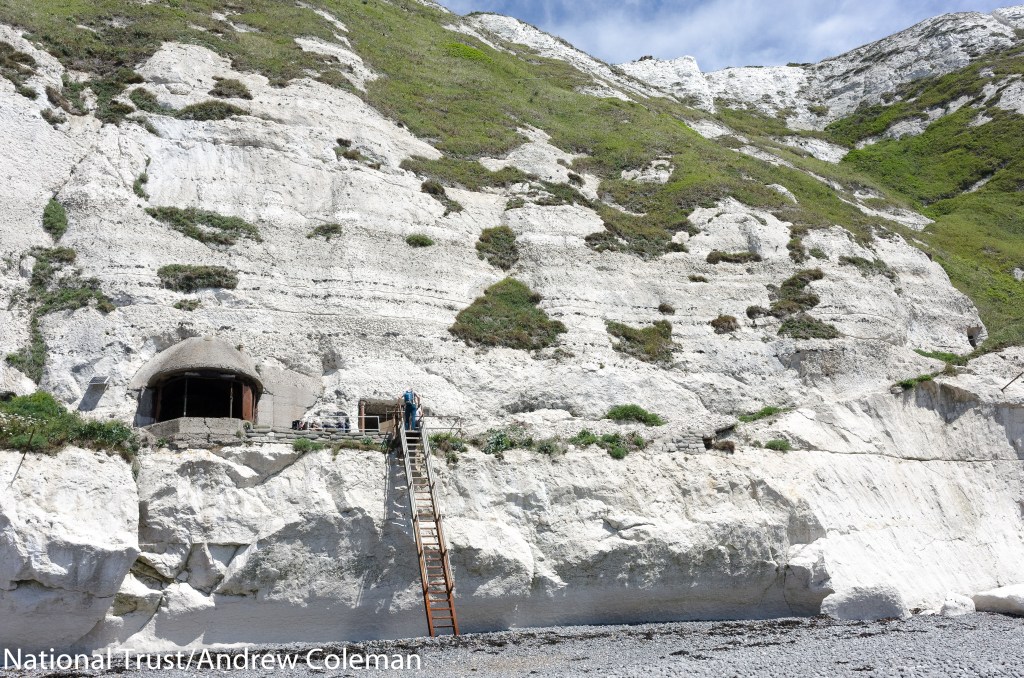
Image reproduced by kind permission of the National Trust: https//www.nationaltrust.org.uk
Firstly, before looking at their possible origins, it may help an understanding by considering some key features of the environment in which flint was formed – the chalk seabed.
Chalk was formed from coccoliths (microscopic shells) originating from a type of calcareous single-celled algae called coccolithophores (a type of microscopic plankton). In the “hot house” climate of the Upper Cretaceous, about 101 to 66 million years ago, the seas were sufficiently warm to produce blooms of coccolithophores. As they died, they produced a steady shower of calcareous debris, and some organic remains, which accumulated as a slightly organic chalky ooze. Over millions of years this compacted under its own weight to form chalk.
The silica needed to form flints was dissolved in the water in the sediment (porewater). It originated from organic sources, particularly sponges, but also Radiolaria and Diatoms (single celled plankton) and perhaps some from inorganic sources such as sub-sea volcanic eruptions. The organic content of the sediment derived from the bodies of animals and plants. This provided food for bacteria which, after burial for some time, broke down the organic matter releasing sulphur in the form of sulphates (sulphur combined with oxygen).
The mechanisms outlined below by which dissolved silica is transformed to flint are based on those described by Bromley & Ekdale, (1983) and Clayton, (1986). Both mechanisms require the presence of de-oxygenated porewater in the chalk sediment. This usually occurs at a depth where the normal (aerobic) bacteria, feeding on organic debris, deplete the oxygen to below levels needed for aerobic bacteria to function and which is too far below the seabed for oxygenated water to permeate and replenish oxygen. At this depth a primitive type of anaerobic bacteria called sulphate reducing bacteria take over which can function in the absence of oxygen. The boundary between deoxygenating (reducing) and oxygenating conditions is the Redox Boundary. The depth to this boundary depends on the permeability of the chalk sediment and its organic content, but depths of 10cm to 10m below the seabed have been quoted. In the absence of other variables, the Redox Boundary would be parallel to the seabed, the source of the oxygenated seawater.
The Bromley model describes a situation where silica is precipitated directly as small nodules which accrete as flint. This mechanism more easily explains the formation of discrete flint fossils such as shells and sea urchins (echinoids).
The Clayton model has a wider application and can explain the formation of most types of flint but the process is more complicated. In this model the silica passes through several intermediate phases before precipitating as micro-crystalline silica (flint). A detailed description of the chemical reactions is not included here but it is described in Clayton (1986).
The process starts at shallow depths in the chalk sediment after it had been deposited but before it had become fully compacted into solid chalk. The first requirement is for the silica dissolved in the sediment to be precipitated. This was initiated by the anaerobic decomposition of organic matter below the Redox Boundary.
This is a well know process which occurs in many fine-grained sediments containing organic matter (silts and clays). In these sediments, anaerobic decomposition releases sulphur as a sulphide (sulphur with no oxygen) which can end up as iron sulphide (FeS, pyrite or “Fools Gold”) in the resulting clays and shales. But there is very little iron in chalk sediment, so the sulphur combines with hydrogen forming hydrogen sulphide gas (H2S, which smells of rotten eggs). This bubbles upwards within the sediment and where it meets the oxygenated sediment and oxidises to sulphuric acid (H2SO4).
This acid as two effects. It causes silica dissolved in the porewater to precipitate. It starts off as a type of opal, which is silica with molecularly bound water, but with time and increasing pressure the water is driven off and the remaining silica eventually crystallises as flint. Secondly, the acid dissolves chalk enlarging any permeable pathways in the chalk which preferentially contain a higher concentration of porewater.
Occasionally there is some iron in the chalk sediment and you can sometimes see orange-brown iron staining concentrated on the underside of sheet flints. The position on the underside suggests that it is not a recent permeation from the surface but that it had risen from below in the chalk ooze at an early stage (see Photo 2).
So, the depth of Redox Boundary influences the location of flint production. In a condition of constant sedimentation this boundary would rise uniformly through the sediment maintaining the distance below the seabed at which oxygen depletion occurs. If this was the case, why isn’t flint found uniformly within the chalk following the rise of the Redox Boundary through it?
The flints in Photo 1 show the typical arrangement of flints in arranged in bands; they are not uniformly distributed. One suggestion is that variations in the type of sedimentation resulted in permeable layers which allowed pathways for silica rich porewater to enter the sediment. This would explain those flint bands which are of limited horizontal extent, but a key feature of many flint bands is that they can be traced over hundreds of kilometres (from North Yorkshire to northeastern France for example). Such widespread features are unlikely to be the result of sedimentary processes but point to a global influence. Climate variation is the most likely candidate to cause global effects.
There are several ideas on how temperature could have affected the seabed sediments. The simplest is that the amount of plankton available to provide the chalk sediment varied following regular variation between hot house and more temperate conditions. A similar idea involves the variation the of silica in the seawater. Another idea involves the Redox Boundary and the length of time required to complete silica precipitation. This suggestion is that cooling would reduce the plankton blooms and accumulation of sediment, allowing the Redox Boundary to remain stationary long enough to complete the silica precipitation process.
So, the next question is what caused this global variation?
A current idea is based on the recognition that dates of flint bands show a periodicity of roughly 21,000 or 41,000 years which is similar to the periodicity of two of the Milankovitch Cycles. Milankovitch Cycles are a regular, long term, variation in the orbit and tilt of the Earth around the Sun which affects the amount of the Sun’s heat reaching the Earth. (For further details see the section on Milankovitch Cycles in “Determining a timetable of glaciations”). It is suggested that flint formation coincided with the cooler parts of the Milankovitch Cycles which caused the coccolithophore blooms to disappear which reduced the build-up of sediment on the seabed. This allowed the Redox Boundary to remain at the same depth below the seabed for long enough for the process of silica precipitation to complete, although the solid precipitate at this stage was a form of opal (silica with molecularly bound water). Restoration of normal hothouse temperatures re-started sedimentation along with movement of the Redox Boundary up through the sediment until the next cooling period.
This may explain the regularity of flint bands on the larger scale, but there are irregularities in the orientation of flint bands on a smaller scale. So what caused this?
The seabed was subject to episodes of tectonic (deep seated) uplift and tilting which caused faulting, slumping, and short lived but vigorous tectonically induced currents which scoured the seabed (Tsunamis?). These disruptions, in the otherwise uniformly stratified sediments, produced local variations in permeability which allowed accumulations of silica-rich porewater.
Examples flint which most convincingly do not conform to the regular banding, are the steeply inclined sheet flints and which are sometimes cut-off and displaced along horizontal fault planes. These inclined sheet flints have been interpreted as forming on fault or slump surfaces (R. Mortimore, 2011, Fig.67, Clayton, 1986 Fig. 4.1c). It has also been suggested that the permeation of silica-rich fluid, under pressure, is likely to have been involved.
Flints formed on these surfaces are sheet flints. They are usually less than 50mm thick but can be quite extensive. A good example of sheet flint can be seen in the National Trust’s Fan Bay Deep Shelter shown in Photo 2. In this example, the sheet flint is parallel with the bedding and can be followed along the tunnel system. Here, the silica rich water preferentially followed a more permeable discontinuity in the bedding; these can be formed by lithological variations or a bedding plane fractures.
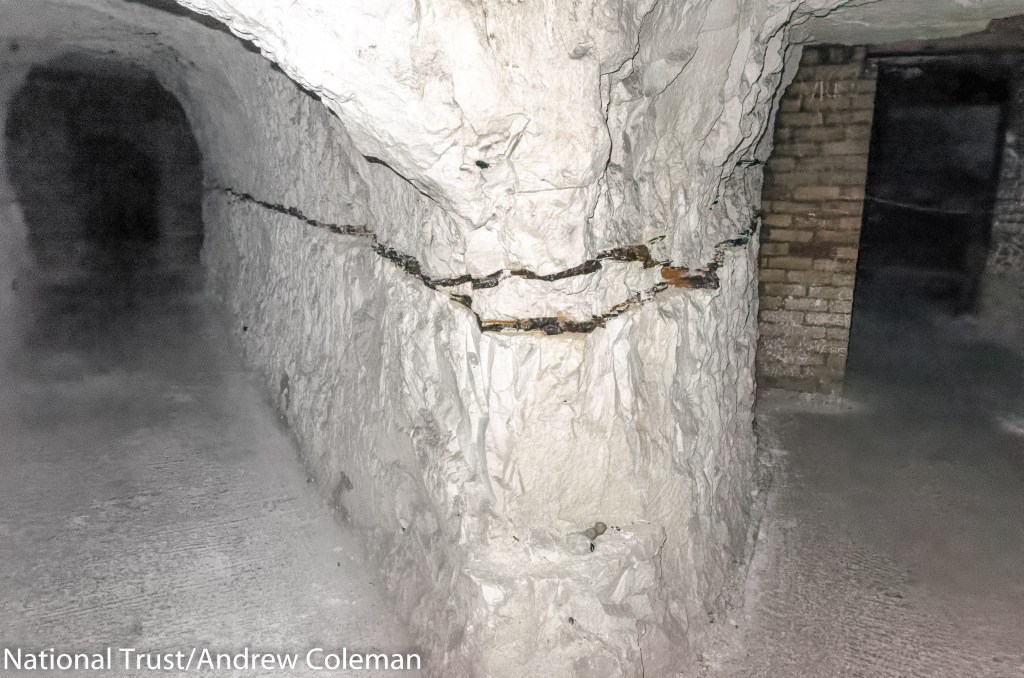
Image reproduced by kind permission of the National Trust: https//www.nationaltrust.org.uk
It is difficult to attribute the formation of the chalk lens in Photo 2 to simple sedimentation. The lens is enveloped by a surface which combines on each side of the lens; deposition of successive layers could not form such a surface. Some post-depositional process must have occurred to produce this feature. Mortimore (2019 Fig. 32) explains such lenses as chalk blocks which have been rolled and elongated by horizontal shear movements. But this block is extremely “streamlined”, it gives the appearance of being formed by flowing water. Perhaps it was produced by one of those Tsunami currents flowing across the seabed?
A deviation: If you are visiting the Fan Bay tunnels, at the location of the lens structure in Photo 2, take the opportunity to view a rare example of a well-preserved fragment of fossil clam shell in the roof above your head. Follow this link to see Cladoceramus undulatoplicatus (Snowshoe Clam).
There were also biological processes which produced local variations in the chalk sediment after its initial deposition. Bottom living animals found the seabed an ideal habitat for creating burrows for feeding or protection. Disused burrows became filled with fine debris which was more permeable than the surrounding sediment. This local increase in permeability influenced the location and shape of the precipitating silica. The flints formed from this process are called “Burrow-Form Flints”. They are internal moulds of animal burrows, albeit enlarged and distorted by subsequent acid dissolution of the surrounding chalk. These are the commonest flints. They are those knobbly shaped flints which you may see used as building stones or come across in fields in the Chalk Downland of southern England.
An uneven concentration of decaying organic matter also altered the rate of oxygen depletion by anaerobic bacteria. For example, a large mass of decaying matter could have attracted a high concentration of bacteria with a high oxygen demand resulting in local reducing conditions, even if it was above the main Redox Boundary. In this situation the Redox Boundary would have been a three-dimensional surface surrounding an anaerobic core.
This process may have been the origin of a third type of flint, the Paramoudra flints, sometimes called Pot Stones. These are roughly cylindrical in form and up to about 0.5m in diameter and slightly taller. Giant Paramoudras are aggregates of flints which can be several metres in diameter. (The normal Paramoudras and Giant Paramoudras are probably different things, and it might be appropriate to use the term Potstone for the normal Paramoudras.)
The normal Paramoudras have a hole through the vertical axis or, if not, a hard chalky core. Some can be pebble sized with a small central hole penetrating them. Photo 3 shows a slightly wave battered example of a Paramoudra (without a chalky core) on the beach at Ness Point southwest of St Margaret’s Bay. Photo 4 shows one in-situ in the cliffs at Pegwell Bay in north Kent showing how it protrudes from a flint band.
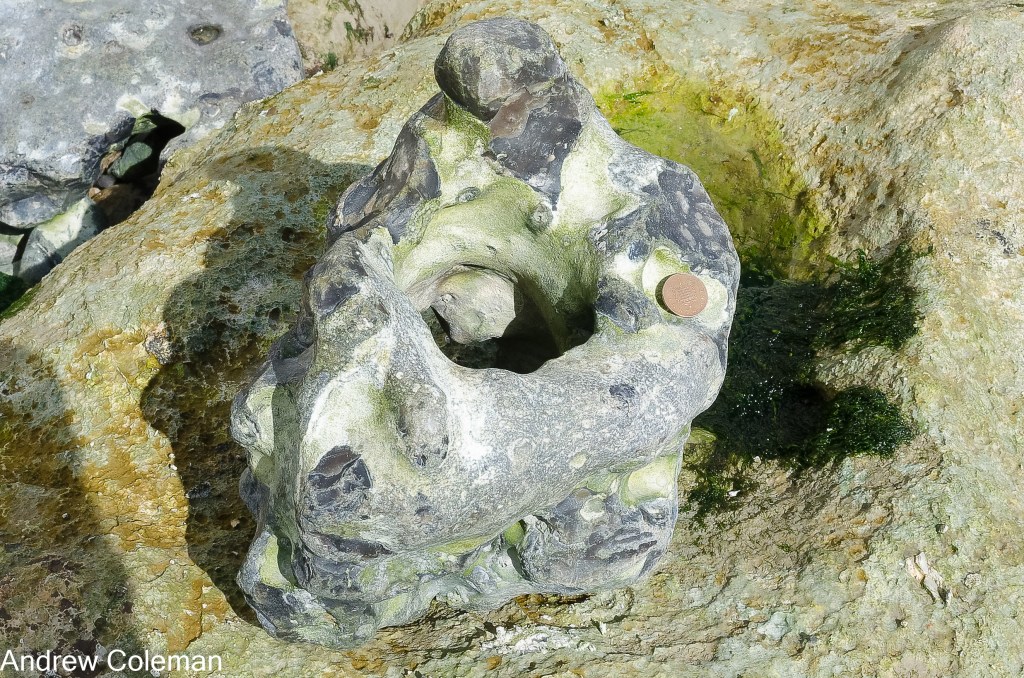
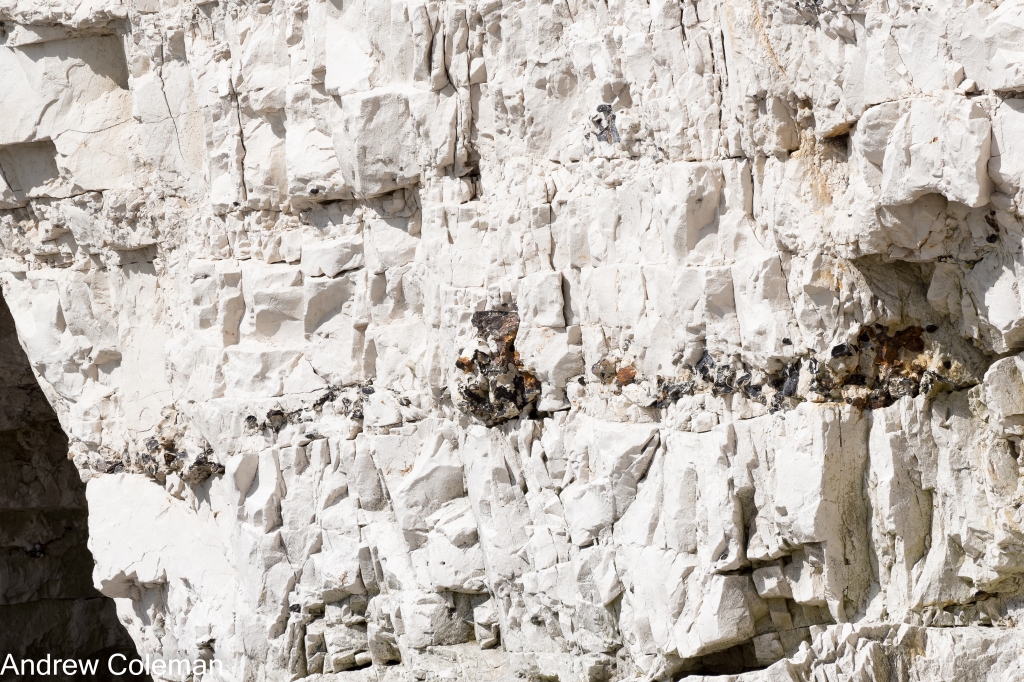
Giant Paramoudras can reach nine metres high (seen in cliffs) and up to two metres in diameter. (Bromley et al., 1975, R. G. Bromley & Ekdale, 1986) Rather than being a single flint they are an aggregate of flints. When seen in section, in cliff faces, they show an irregular shape and when they pass through a flint band, the flint may extend into it.
The chalky core frequently has a trace fossil, a tube or track of a creature, which Bromley et al., (1975) called Bathichnus (from Greek, deep trace). According to the Redox Boundary model, this creature would have been the origin of the organic matter decomposing in anaerobic conditions and the Redox Boundary would have been a vertical cylinder surrounding a decomposing core. Given that these Giant Paramoudra can be several metres tall, and pass through chalk spanning several million years, it requires the creature living in the central core to have been very long and very long-lived. So the origin of these paramoudras must be different from other flints.
These were described as fossilised sponges in the 19th century and Yeomans, (2018) has spent much time refining this idea. Photo 5 shows the top of a partly submerged Giant Paramoudra on the shore at West Runton Beach, Norfolk. This example is about a metre and a half in diameter. It also shows a gap in the circumference which Yeomans, (2018) refers to as the “exhalent dip” found in most Paramoudras. These are always orientated in the same direction which Yeomans attributes to the prevailing current, which tends to support the sponge origin rather than silica accretion.
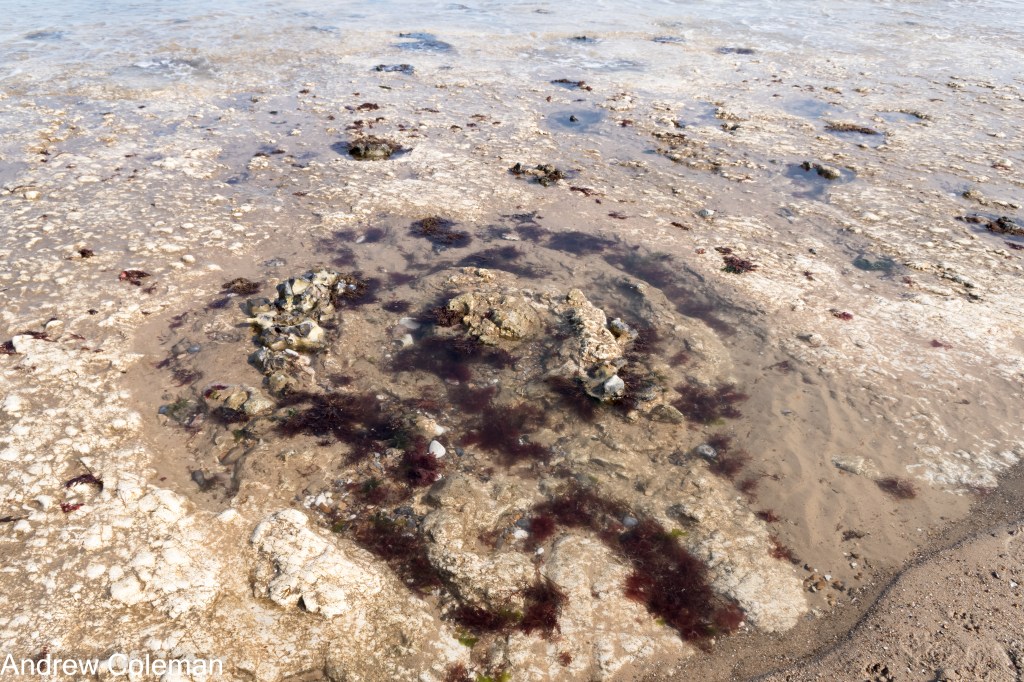
Yeomans (2018) has identified a large Cretaceous seabed reef on the foreshore at West Runton, comprised of Giant Paramoudra flints. They show a north easterly alignment which he attributes to the effect of the prevailing sea-bed currents.
Andrew Coleman
Rev. 23/10/2025
References:
Bromley, G. R., Schulz, M.-G., & Peake, N. B. (1975). Paramoudras: Giant Flints, Long Burrows and the Early Diagenesis of Chalks. The Royal Danish Academy of Sciences and Letters., 20(10), 1–31.
Bromley, R. G., & Ekdale, A. A. (1983). Flint and fabric in the European chalk. In G. de G. Sieveking & M. B. Hart (Eds.), The scientific study of flint and chert. (pp. 71–87). Cambridge University Press.
Clayton, C. J. (1986). The chemical behaviour of flint formation in Upper Cretaceous chalks. In G. D. G. Sieveking & M. B. Hart (Eds.), The scientific behaviour of flint and chert (pp. 43–54).
Mortimore, R. (2011). A chalk revolution: What have we done to the Chalk of England? In Proceedings of the Geologists’ Association (Vol. 122, Issue 2, pp. 232–297). https://doi.org/10.1016/j.pgeola.2010.09.001
Mortimore, R. N. (2019). Late Cretaceous to Miocene and Quaternary deformation history of the Chalk: Channels, slumps, faults, folds and glacitectonics. Proceedings of the Geologists’ Association, 130(1), 27–65. https://doi.org/10.1016/j.pgeola.2018.01.004
Yeomans, R. (2018). Paramoudra: Observations on large flint structures from the Chalk (Upper Cretaceous) and flint formation. Proceedings of the Yorkshire Geological Society, 62(3), 210–216. https://doi.org/10.1144/pygs2017-005
 Geomusings